Xero works well for small businesses that only need basic bookkeeping. But once a company starts hiring, adding locations, tracking inventory, or managing projects alongside finance, Xero's limits show up fast. That is why so many growing US businesses are searching for a Xero to Business Central migration path in 2026.
Microsoft Dynamics 365 Business Central is a full cloud ERP that covers finance, sales, inventory, purchasing, projects, and warehouse management in one connected system. Unlike Xero, it is built to scale from 10 users to several hundred, and it comes with native Microsoft 365, Power BI, and Copilot integration.
This guide walks through exactly why businesses outgrow Xero, how Xero and Business Central compare on features and 2026 pricing, what a migration actually involves, how long it takes, what it costs, and the mistakes that derail projects. Everything here reflects current Microsoft and Xero pricing, verified for 2026.
Table of Contents
- What Is Xero and Where Does It Fall Short for Growing Businesses?
- What Is Microsoft Dynamics 365 Business Central?
- Xero vs Business Central: Full Feature Comparison
- Xero vs Business Central: 2026 Pricing Comparison
- 7 Signs Your Business Has Outgrown Xero
- Key Benefits of Migrating from Xero to Business Central
- Xero to Business Central Migration: Step-by-Step Process
- Migration Timeline: How Long Does It Take?
- Common Migration Mistakes to Avoid
- Xero to Business Central Migration Cost: What to Budget For
- Frequently Asked Questions
- Why Choose Dynamics Square for Your Xero to Business Central Migration
What Is Xero and Where Does It Fall Short for Growing Businesses?
Xero is cloud accounting software built for small businesses and their bookkeepers. It handles invoicing, bank reconciliation, bill payments, and basic reporting well, but it is not an ERP system, so it cannot manage inventory, manufacturing, warehouse operations, or multi-entity consolidation on its own.
Xero organizes its US plans into three tiers: Early, Growing, and Established. The Early plan caps usage at 20 invoices and quotes plus 5 bills per month, which is enough for a freelancer but restrictive for an operating business. Growing and Established remove those caps and add features like dashboards, financial scorecards, multi-currency support, and project tracking, but even the top Established tier stays focused on accounting rather than end-to-end business management.
Common pain points businesses report as they grow:
No native inventory, manufacturing, or warehouse management
No built-in payroll in the US (requires a Gusto or third-party integration)
Reporting stays finance-centric, with no unified view across sales, operations, and service
Customization is limited compared to a true ERP platform
Scaling to multiple entities, currencies, or countries becomes harder to manage cleanly
None of this makes Xero a bad product. It is simply an accounting tool, not an ERP, and that distinction is exactly why businesses eventually look at Business Central.
What Is Microsoft Dynamics 365 Business Central?
Dynamics 365 Business Central (often shortened to D365 BC) is Microsoft's cloud ERP for small and midsize businesses. It combines financial management, sales, purchasing, inventory, warehousing, project management, and service management in a single platform, with built-in Copilot AI and direct integration into Microsoft 365, Power BI, and the Power Platform.
Because it runs in Microsoft's cloud, teams get real-time data across departments instead of siloed spreadsheets. A sales order can automatically update inventory, trigger a purchase order, and post to the general ledger without manual re-entry. For companies already using Outlook, Excel, and Teams, Business Central plugs directly into tools employees already know, which shortens the learning curve significantly.
Business Central also supports both cloud (SaaS) and on-premises deployment, so businesses with specific compliance or infrastructure needs still have flexibility that Xero, as a cloud-only product, does not offer.
You can explore the full feature set on our Business Central blog page.
Xero vs Business Central: Full Feature Comparison
| Capability | Xero | Business Central |
|---|---|---|
| Core focus | Accounting and bookkeeping | Full ERP: finance, sales, inventory, purchasing, projects, warehouse |
| Inventory management | Basic, add-on dependent | Native, with warehouse and item tracking |
| Manufacturing support | Not available | Available on Premium |
| Built-in AI (Copilot) | Limited (JAX chat) | Yes, across finance, sales, and operations |
| Microsoft 365 integration | Limited | Native, deep integration with Outlook, Excel, Teams |
| Power BI / Power Platform | Not native | Native integration |
| Payroll (US) | Requires Gusto integration | Available through partner add-ons |
| Multi-entity / multi-currency | Established plan only | Native, built for multi-entity consolidation |
| Deployment | Cloud only | Cloud (SaaS) or on-premises |
| Customization | Limited | Highly customizable via extensions and AL code |
| User scaling | Unlimited users, but feature-limited | Scales from a handful of users to 500+ |
Xero vs Business Central: 2026 Pricing Comparison
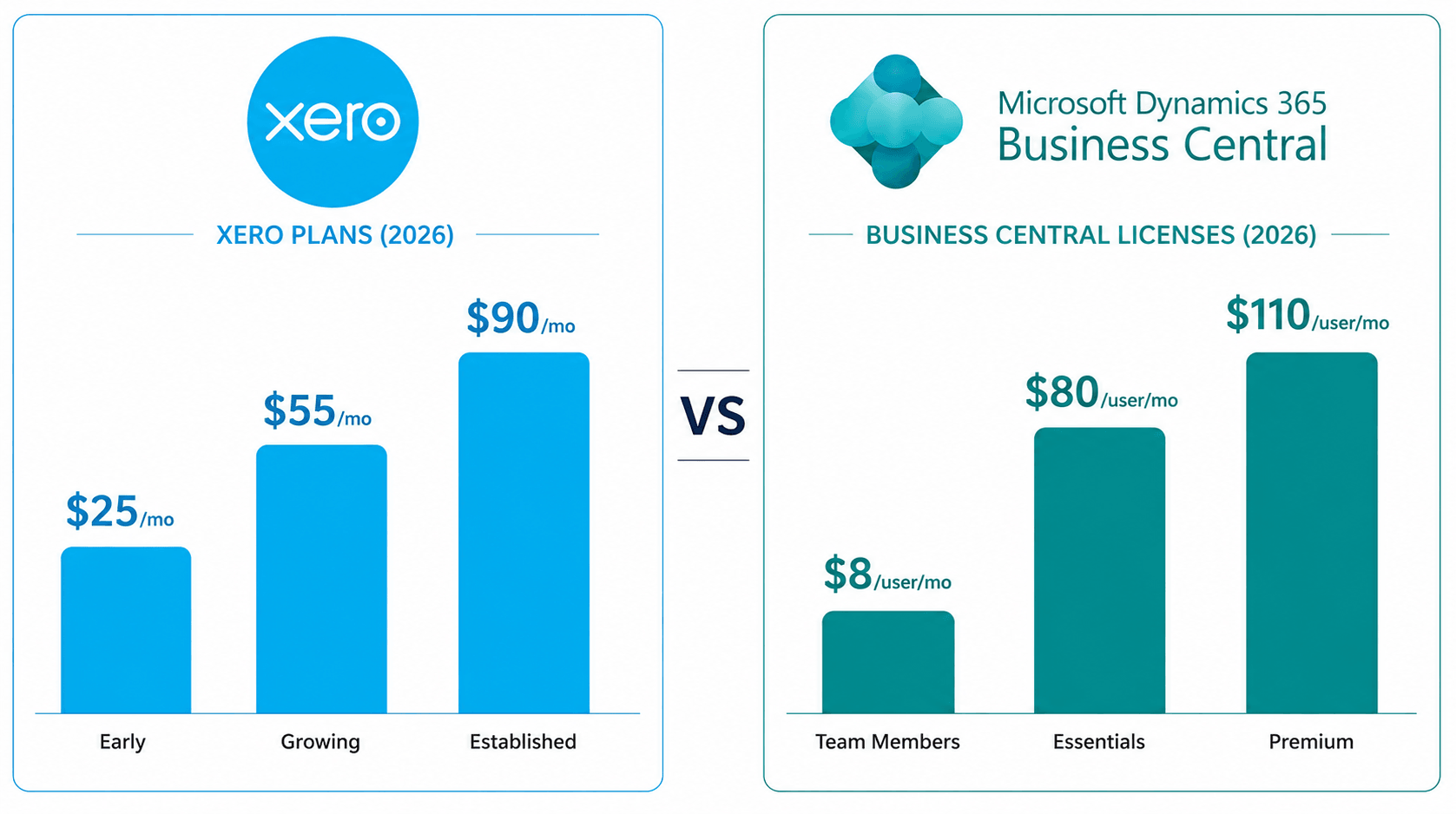
Pricing is one of the most-searched parts of this decision, and it is also where a lot of published guides go stale fast. Here is what both platforms actually cost in the US as of mid-2026. For the official breakdown of license types, see Microsoft's Business Central licensing documentation.
Xero US pricing (regular monthly rate, billed monthly):
| Plan | Monthly Price | Key Limits |
|---|---|---|
| Early | $25/month | 20 invoices/quotes and 5 bills per month |
| Growing | $55/month | Unlimited invoices and bills, no multi-currency |
| Established | $90/month | Unlimited invoices/bills, multi-currency, projects, expense claims |
Business Central US licensing (per user, per month, billed annually):
| License Type | Monthly Price | Best For |
|---|---|---|
| Essentials | $80/user/month | Core ERP: finance, sales, purchasing, inventory |
| Premium | $110/user/month | Everything in Essentials, plus manufacturing and service management |
| Team Members | $8/user/month | Light users who only need to view data or submit basic entries |
Microsoft raised these prices on November 1, 2025 (Essentials moved from $70 to $80, Premium from $100 to $110), so any comparison still quoting the old numbers is out of date. Xero's plan pricing has also shifted since 2024, with the Early plan now capped much more tightly at 20 invoices and 5 bills, down from the higher limits older guides still reference.
At first glance, Xero looks cheaper because it is priced per organization, not per user. But that comparison only holds if your needs stop at accounting. Once you factor in the cost of separate inventory, payroll, and reporting tools most growing Xero users end up paying for anyway, Business Central's per-user ERP pricing often works out to be the more efficient spend, because one platform replaces several point solutions.
Run your own numbers with our ERP implementation cost calculator to see a full budget estimate, not just license fees.
7 Signs Your Business Has Outgrown Xero
If more than two or three of these sound familiar, it is worth evaluating Business Central seriously:
You are manually re-entering data between Xero and a separate inventory or CRM tool
Month-end close takes days because reports live in different systems
You have outgrown Xero's Early plan limits and are paying for Established just to get basic features
You need to manage inventory, warehouse locations, or manufacturing, and Xero cannot support it natively
You are expanding to a second entity, currency, or country
Your finance team spends more time exporting data to Excel than analyzing it
Leadership is asking for real-time dashboards Xero cannot produce without add-ons
Key Benefits of Migrating from Xero to Business Central
Unified operations, not just accounting: Sales, inventory, purchasing, and finance update in real time from a single system, so there is no lag between what operations sees and what finance reports.
Built-in AI and automation: Business Central's Copilot features handle tasks like bank reconciliation suggestions, sales forecasting, and cash flow insights automatically, work that typically requires manual effort or a third-party tool in Xero.
Deeper Microsoft ecosystem integration: Because Business Central is a Microsoft product, it works natively with Excel, Outlook, Teams, and Power BI. Reports and dashboards can be built and shared without exporting data to another platform.
True scalability: Business Central is designed to support a business from its first ERP rollout through hundreds of users, multiple entities, and international operations, without switching platforms again.
Stronger customization: Through the Power Platform (Power Apps, Power Automate) and AL-based extensions, businesses can tailor workflows, approval chains, and industry-specific processes in ways Xero's more rigid structure does not allow.
Centralized, auditable data: With one source of truth across departments, businesses get more accurate reporting, better audit trails, and fewer reconciliation errors between disconnected systems.
Xero to Business Central Migration: Step-by-Step Process
A structured migration reduces risk and downtime. Here is the process an experienced implementation partner typically follows.
Step 1: Assess your business requirements: Identify which Business Central modules matter most (finance, inventory, projects, manufacturing) so the implementation stays scoped to what you actually need, not every available feature.
Step 2: Choose a Microsoft Dynamics 365 implementation partner: A certified partner brings migration templates, industry experience, and a structured methodology that in-house teams rarely have the bandwidth to build from scratch. See how our Business Central implementation services cover this end to end.
Step 3: Audit and clean your Xero data: Before anything moves, export your chart of accounts, customers, vendors, items, and open balances from Xero, and clean up duplicates or inconsistent records. Data quality at this stage determines how smooth the rest of the migration goes.
Step 4: Map data and design the new structure: Your partner maps Xero's chart of accounts and records to Business Central's data model, and helps you decide on dimensions (department, location, project, and so on) for future reporting.
Step 5: Configure and customize Business Central: Set up core modules, approval workflows, user roles, and any needed extensions or integrations (e-commerce, CRM, industry-specific tools).
Step 6: Migrate and validate data: Data is moved in a test environment first, validated against Xero records, and reconciled before anything goes live. This step should never be skipped, even under deadline pressure.
Step 7: Train your team: User adoption determines ROI. Role-based training for finance, sales, and operations staff ensures the system gets used the way it was designed to be used.
Step 8: Go live and stabilize: After go-live, expect a short stabilization period where your implementation partner monitors performance, fixes edge cases, and fine-tunes reports.
Businesses that also use Xero for ongoing bookkeeping during a phased transition can integrate the two systems temporarily, but most companies fully cut over to Business Central once validation is complete, to avoid maintaining two sources of truth.
Migration Timeline: How Long Does It Take?
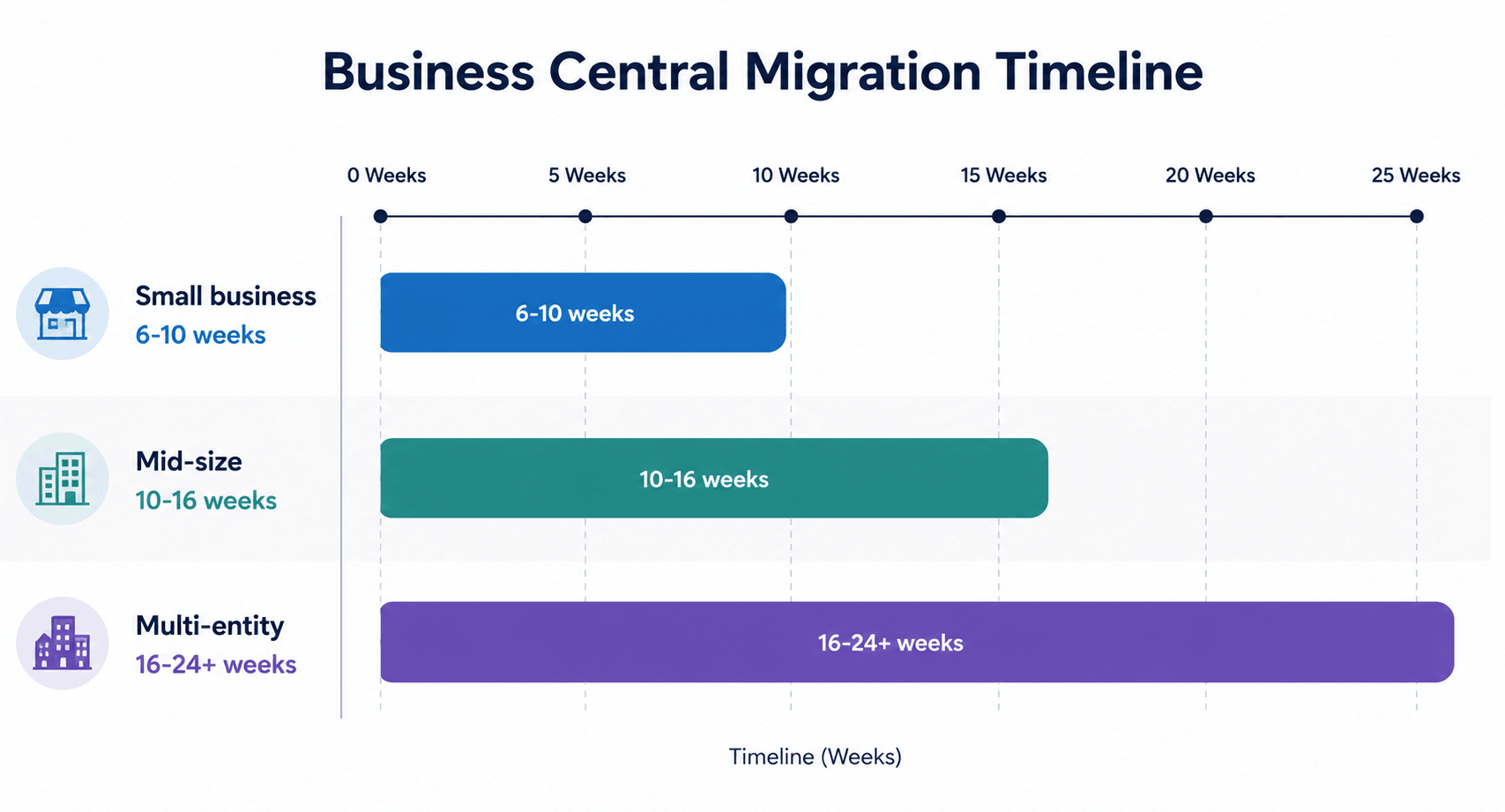
Timelines vary by company size and scope, but a typical Xero to Business Central migration follows this rough pattern:
Small business, finance-only scope: 6 to 10 weeks
Mid-size business with inventory and multiple departments: 10 to 16 weeks
Multi-entity or multi-currency migration with custom integrations: 16 to 24+ weeks
Data cleanup and stakeholder availability are usually the biggest factors that extend a timeline, more than the technical migration itself.
Common Migration Mistakes to Avoid
Skipping data cleanup: Migrating messy or duplicate data from Xero just moves the problem into Business Central.
Underestimating training time: A powerful ERP that employees do not know how to use will not deliver ROI.
Choosing a partner without US-specific experience: Tax rules, 1099 reporting, and multi-state compliance differ from what UK- or Australia-focused partners typically handle.
Trying to migrate everything at once: Phased rollouts (finance first, then inventory and projects) reduce risk for larger organizations.
Not planning for integrations early: If you use e-commerce, CRM, or industry-specific tools alongside Xero, map those integrations before go-live, not after.
Assuming go-live is the finish line: Most issues surface in the first 60-90 days of real use. Lining up Business Central support services before go-live avoids scrambling for help later.
Xero to Business Central Migration Cost: What to Budget For
There is no single number here, because cost depends on data volume, number of users, modules needed, and integration complexity. In general, budget for these components:
Business Central licensing: based on your mix of Essentials, Premium, and Team Member users (see pricing table above)
Implementation and data migration services: varies significantly by scope and company size; small, finance-focused migrations sit at the lower end, while multi-entity or manufacturing implementations with custom integrations run considerably higher
Training: role-based sessions for finance, sales, and operations teams
Ongoing support: many businesses budget an annual support retainer for upgrades, troubleshooting, and configuration changes after go-live
Because scope varies so much, the most reliable way to budget accurately is a free migration assessment from a Microsoft Dynamics 365 partner, rather than relying on a generic industry average.
Migrating from a different legacy system instead? See our guides on QuickBooks to Business Central migration, Sage to Business Central migration, and Dynamics GP to Business Central migration.
Frequently Asked Questions
Is Xero an ERP system?
No. Xero is cloud accounting software focused on invoicing, bank reconciliation, and financial reporting. It does not include native inventory management, manufacturing, or warehouse functionality, which is why growing businesses eventually pair it with, or replace it entirely with, an ERP like Business Central.
Why do businesses switch from Xero to Business Central?
Businesses typically switch when they need inventory management, multi-entity operations, deeper reporting, or tighter Microsoft 365 integration than Xero can provide. Business Central consolidates finance and operations into one platform instead of stitching together multiple point tools.
How much does it cost to migrate from Xero to Business Central?
Cost depends on your data volume, user count, and module scope. Licensing runs $80 to $110 per full user per month, plus implementation and training costs that vary by project complexity. A certified partner can provide an accurate quote after a requirements assessment.
How long does a Xero to Business Central migration take?
Most finance-focused migrations for small businesses take 6 to 10 weeks. Larger, multi-department or multi-entity migrations typically take 3 to 6 months.
Can I run Xero and Business Central at the same time during migration?
Yes, many businesses run both temporarily during a phased transition, but most fully cut over once data validation is complete to avoid maintaining two systems of record long-term.
Does Business Central integrate with tools I already use with Xero?
Business Central connects natively with Microsoft 365, Power BI, and the Power Platform, and supports integrations with e-commerce, CRM, and industry-specific tools through its API and partner ecosystem.
Why Choose Dynamics Square for Your Xero to Business Central Migration
Dynamics Square has spent 15+ years helping US businesses implement, migrate, and support Microsoft Dynamics 365 solutions, including Business Central. Our certified consultants bring hands-on experience across industries such as distribution, manufacturing, professional services, and retail, so your migration is planned around how your business actually operates, not a generic template.
We handle the full lifecycle: requirements assessment, data migration, configuration, integration, training, and ongoing support after go-live. Whether you need a straightforward finance migration or a phased, multi-entity rollout, our Business Central implementation team designs the roadmap around your timeline and budget.
Dynamics Square supports clients across the USA, with a presence in the UK, Canada, and beyond. Reach our regional teams directly:
California: +1 213 784 0845
Texas: +1 281 899 0865
Get in touch with our consultants for a free Xero to Business Central migration assessment.