
Your Journey to Dynamics 365 Starts Here!
Fill in your business details and let
us be your partner in growth.

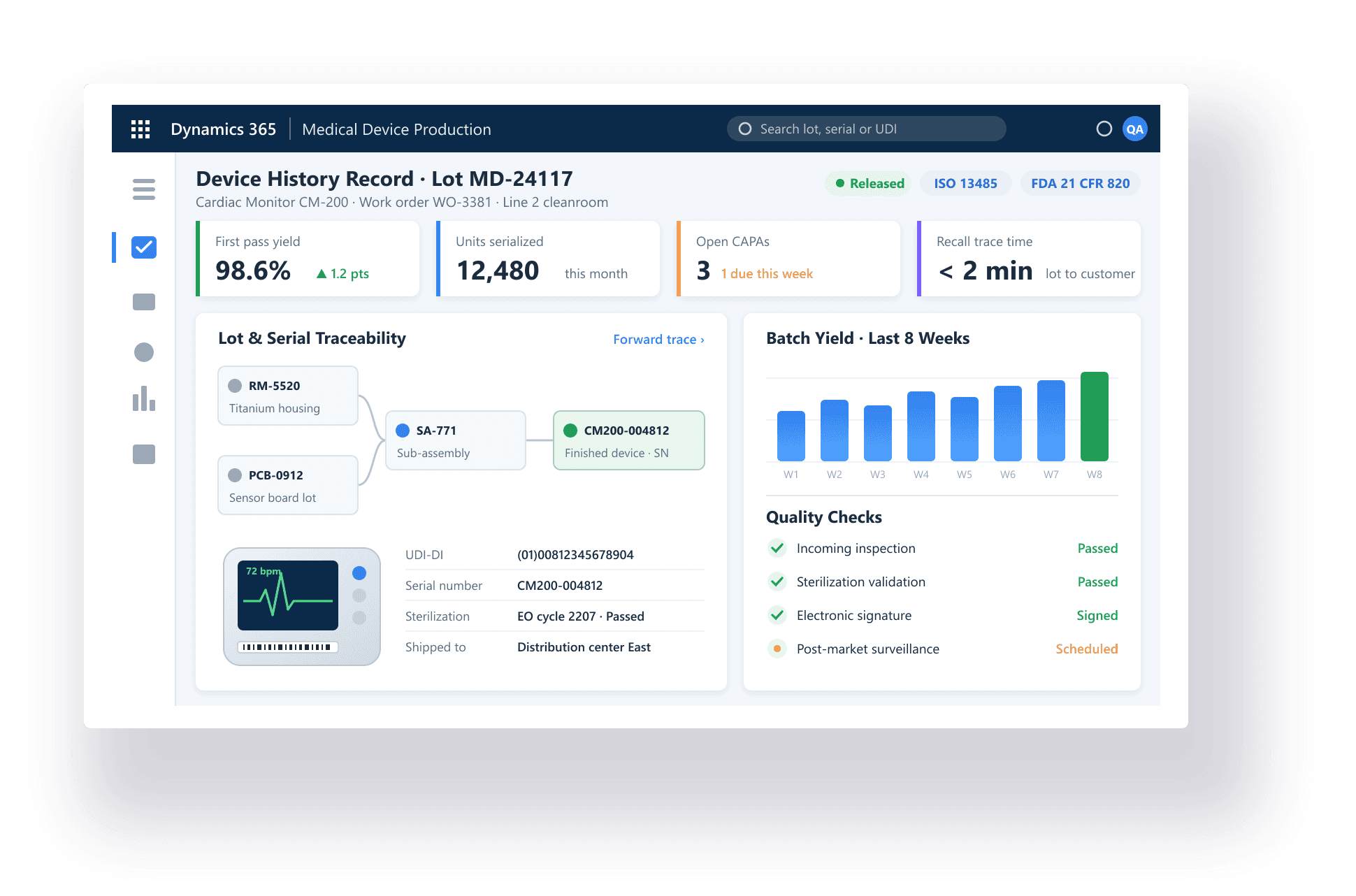
Dynamics 365 ERP for Medical Device Manufacturing brings lot and serial traceability, device history records, and audit-ready quality management, on a single platform. Dynamics Square, a Microsoft Solutions Partner, configures Dynamics 365 ERP around FDA and ISO 13485 requirements, so you can always stay compliant.
Successful Implementations
Certified Dynamics 365 Consultants
Business Central & Supply Chain Management Expertise
Dynamics 365 ERP for medical device manufacturing configures Microsoft's cloud ERP platform around the specific demands of building regulated devices: multi-level bills of materials, engineering revisions, lot and serial identification, and a device history record for every unit that ships. Production, inventory, quality, and finance run from one system, so a component lot can be traced into a finished device and out to the customer who received it, without a manual cross-reference between spreadsheets.
Two products in the Dynamics 365 family cover medical device manufacturing, and the right starting point depends on how complex your build actually is.

Fits smaller and mid-sized device manufacturers: contract manufacturers, single-facility producers, and companies building devices from a defined, moderately complex bill of materials.

The step up for multi-site device makers, companies pushing through frequent engineering changes, and operations that need deep non-conformance and CAPA tracking built in from day one.
Neither product carries FDA clearance nor an ISO 13485 certificate. Regulatory compliance belongs to your quality system, validated by your organization and assessed through FDA inspection. What the right Dynamics 365 configuration supplies is the lot and serial data, the change history, and the documented quality records that make that assessment go smoothly.
See Which Dynamics 365 Product Fits Your Operation
The FDA's Quality Management System Regulation took effect February 2, 2026, replacing the decades-old Quality System Regulation and incorporating ISO 13485:2016 directly into 21 CFR Part 820. Device manufacturers now work to one harmonized standard, and every process, from design transfer to supplier evaluation, gets measured against it.

A device correction or removal initiated to address a health risk has to be reported to the FDA within 10 working days under 21 CFR Part 806. That clock starts the moment you decide to act, and deciding fast depends entirely on knowing which lots, serials, and customers are actually affected. Generic inventory software tells you what's on the shelf. Where a specific unit actually went is a separate question entirely.

A multi-level bill of materials with a routing, a revision history, and a supplier for every component gets unmanageable in a spreadsheet within a single product cycle. Getting the right ERP in place before that complexity compounds is far cheaper than untangling it after the fact.
Every component lot and every serialized unit is tracked from receipt through assembly, test, and shipment, so a single query shows a finished device's complete component history in either direction.
Production order data, inspection results, and disposition records accumulate automatically against each batch or serialized unit, giving you the documentation FDA expects to see for how a specific device was actually built.
Set up inspection checkpoints, grade results pass or fail, and route anything that fails straight to quarantine, all native to Business Central. Supply Chain Management builds on that foundation with formal non-conformance investigation, CAPA workflows, and statistical sampling for operations running more complex quality programs.
Approved vendor lists, incoming inspection results, and supplier corrective action history stay tied to the components those suppliers actually shipped, so a supplier quality issue traces directly to the affected lots.
Multi-level BOMs, routings, and revision history stay linked to production, so an engineering change carries forward into every future build without a manual update across disconnected documents.
MRP and MPS convert demand into a production schedule against real capacity and component availability, keeping engineering changes and supplier lead times factored into the plan from the start.
Medical device manufacturing runs as discrete manufacturing on both Dynamics 365 platforms, a different world from process industries such as pharmaceuticals. The decision here comes down to BOM complexity, quality management depth, and how many sites and entities you're running.
| Aspects | Business Central | Supply Chain Management |
|---|---|---|
| Best fit | Contract manufacturers, single-site device makers | Multi-site manufacturers, complex engineering environments |
| Manufacturing style | Discrete manufacturing (Premium license) | Discrete manufacturing at enterprise scale |
| Lot and serial tracking | Native | Native, with multi-attribute tracking |
| Quality management | Native inspection templates and quarantine | Quality orders, structured non-conformance, CAPA, statistical sampling |
| BOM and engineering complexity | Multi-level BOMs, single revision path | Multi-level BOMs with configurable products and complex change control |
| Organizational scale | One facility, one legal entity | Several entities, several sites, several currencies |
| Company headcount, as a rough guide | Under roughly 250 employees | Above that, or a smaller company with unusually complex production |
| Starting license (USA) | Premium: $110/user/month | Standard: approximately $210/user/month |
A device manufacturer building a defined product line at one facility gets genuine manufacturing and quality functionality out of Business Central Premium, at a cost and rollout timeline sized for a single-site operation. Once you're running multiple sites, managing engineering revisions constantly, or need CAPA and statistical sampling as a standard part of how quality operates, that setup stops being enough, and Supply Chain Management's deeper engine takes over.
Worth stating plainly: neither platform is a design control system. Manufacturers with substantial design history file obligations typically layer a dedicated electronic quality management system on top of Dynamics 365 for design controls and validated electronic signatures, with Dynamics 365 carrying production, inventory, costing, and the device history record underneath. We'll surface this early in discovery if it applies to your operation.
Find the Platform That Fits Your BuildBy now you've seen what each platform can do. Picking between them comes down to matching the ERP to your actual operation.
Get it wrong, and you pay for it twice: once for a system that's the wrong size for you, and again for all the manual work needed to make it fit.
That's why every conversation starts the same way. We look at your bill of materials, how mature your quality process is, how many sites you run, and which rules you need to follow. Then we tell you which platform makes sense for you.
Every deployment goes through five stages under Microsoft's Success by Design framework. For a regulated device manufacturer, that structure earns its keep most during Prepare and Operate, where validation testing and documented sign-off happen before go-live, well ahead of any scramble to catch up after launch.
We map your current production floor, your BOM and routing structure, and where your quality system already stands against FDA and ISO 13485 expectations.
Platform choice, project scope, and governance get confirmed before a single configuration decision gets made.
The system gets built out, historical data gets migrated, and validation documentation gets written in step with the configuration itself, as it happens.
Your team runs user acceptance testing against real production scenarios, trains on the finished system, and works through a cutover plan built around your actual manufacturing schedule.
We stay engaged after go-live, through your first audits, supplier changes, and whatever process refinements come next.
Figures below come from Microsoft's current US pricing list. Total cost also depends on user count, any ISV extensions for design control or eQMS integration, and the shape of your implementation.
Core financials, sales, purchasing, and inventory.
Everything in Essentials, plus production orders, BOMs, routings, work and machine centers, MRP and MPS, and native Quality Management.
Read, approve, and basic self-service access.
Full discrete manufacturing, advanced quality management, and warehouse management.
Adds advanced analytics and financial planning capabilities.
Licensing is only part of the bill. A single-site Business Central deployment generally costs somewhere in the five-figure range once implementation is added in. A multi-site Supply Chain Management build, carrying validation work, data migration, and eQMS integration, climbs well beyond that, often into six figures.
Request a Quote for Your Facility
A Florida-based medical supplies manufacturer running QuickBooks and disconnected systems needed one platform for finance, inventory, sales, and service.
Dynamics Square implemented Dynamics 365 Business Central with Sales and Customer Service, adding True Commerce EDI and Power BI reporting.
The result: tighter operations, accurate financials, stronger sales visibility, and simpler workflows across the team.
Read the Full Case StudyLot and serial traceability, device history records, and quality holds are worked into project scope from the first conversation, built on how FDA and ISO 13485 actually assess a quality system during inspection.
Ask us directly which platform fits, Business Central or Supply Chain Management, and you'll get a direct answer tied to your production complexity, the kind that comes from matching the tool to the job, no matter which product carries the bigger price tag.
Our team stays current on certifications across both platforms, Business Central and Supply Chain Management alike, so what you're comparing is two genuinely understood options, weighed on their merits.
Your quality system keeps evolving after launch, through design changes, supplier updates, and audits. Our involvement continues right alongside it.
Building devices that go inside or onto a patient carries a level of accountability most software vendors rarely think through. Dynamics Square treats that responsibility as the starting point for every medical device engagement.
Yes, for manufacturers of every scale, as long as the platform matches the complexity of the build. Business Central covers smaller and mid-sized device makers well; larger, multi-site operations typically need Supply Chain Management's deeper capability.
Yes, both platforms assign lot or serial identifiers at receipt or production and carry them through every subsequent transaction, giving full traceability from component to finished, shipped device.
Yes, set up inspection checkpoints, grade results pass or fail, and quarantine anything non-conforming, all native to Business Central's Quality Management module. Supply Chain Management scales that up with formal non-conformance investigation, CAPA, and statistical sampling for larger quality programs.
Yes, production, inspection, and disposition data accumulate against each unit or lot automatically, giving you the documented production history the FDA expects to review during an inspection.
FDA clearance and ISO 13485 certification apply to your organization's quality system, achieved through validated processes and assessed by FDA inspection under the Quality Management System Regulation. Dynamics 365 supports that system with traceability, documentation, and quality records that make it easier to demonstrate compliance during an inspection.