
Your Journey to Dynamics 365 Starts Here!
Fill in your business details and let
us be your partner in growth.

Use Dynamics 365 ERP for chemical manufacturing to manage formulas, batch records, hazard data, and test results on a single AI-powered platform. Dynamics Square, a leading Microsoft solutions partner, has a team of expert consultants who work in Business Central and Supply Chain Management every day.
Certified Dynamics 365 Consultants, Overall
Manufacturing and Supply Chain Consultants
Successful Implementations, Overall
Implementations in Manufacturing
Business Central & Supply Chain Management Expertise
USA, Canada & UK Coverage
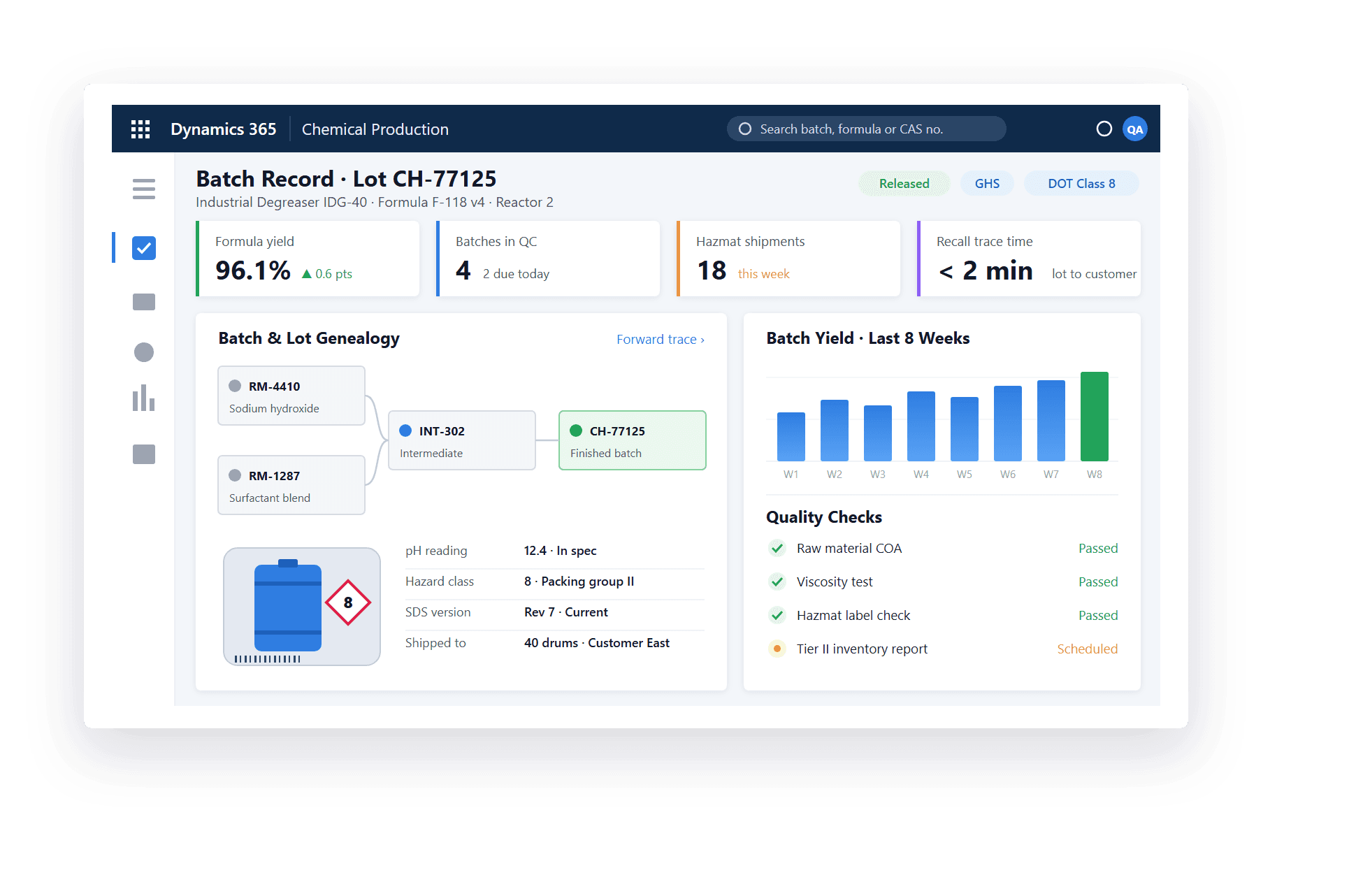
Dynamics 365 ERP for chemical manufacturing is Microsoft's cloud business system set up for companies that blend, react, formulate, and package chemicals. Formulas, batch production, lot records, test results, hazard classifications, and the general ledger live in one database, so a formula change, a batch schedule, and a drum leaving the dock all draw on the same data.
Microsoft Dynamics 365 for chemical manufacturing comes in two products, Business Central and Supply Chain Management. How your recipes behave and how many plants you run decide between them far more than headcount does.
This AI-powered Microsoft ERP suits blenders, formulators, toll manufacturers, and packagers who work from set recipes in a single plant, such as coatings, cleaning products, adhesives, and lubricants.
It helps large producers whose formulas scale by percentage, who generate co-products or by-products, or who run production across several plants and legal entities, as in specialty chemicals, polymers, and industrial intermediates.
OSHA, EPA, and DOT obligations belong to your company and the programs it runs. What Dynamics 365 delivers is the underlying data those programs call on, including which ingredient lot went into which batch, which batch went to which customer, and which hazard class each product carries. The sections below show exactly how that works.
See Which Product Fits Your Operation
OSHA's Hazard Communication Standard (29 CFR 1910.1200) requires hazard labels and a 16-section safety data sheet (SDS) for the chemicals you make. The 2024 revision moved the standard closer to GHS Revision 7. For single substances, manufacturers, importers, and distributors had to comply by May 19, 2026. For mixtures, the date for those same companies is November 19, 2027, which puts every blend and formula under review.

EPCRA Tier II inventory reports are due every March 1 for facilities holding 10,000 pounds or more of a hazardous chemical that requires an SDS, or 500 pounds (or the threshold planning quantity, if lower) of an extremely hazardous substance. TSCA Chemical Data Reporting repeats every four years, with the next submission window running June 1 to September 30, 2028 for calendar year 2027. Both depend on accurate on-hand and production volumes by chemical.

Chemical plants routinely blend, split, and re-use material, so a single raw material lot can end up spread across several batches and dozens of customer shipments. Finding all of them in minutes takes a system that records lot genealogy as production happens.
Business Central keeps recipes as production BOMs with versions and certification status. Supply Chain Management adds formulas with versions, an approval and activation step, scalable and percentage-based formulas, step consumption, and planning items. This is formula management software for chemical manufacturing that grows with your product range.
Ingredients, intermediates, and finished goods each get a lot number and expiration date, which follow the material from the receiving dock through production and storage to the outbound truck. Supply Chain Management also supports batch attributes with target values, minimum and maximum ranges, and warning or error responses when a measured value falls outside the range.
Chemical quality control software has to act on results, and Business Central's native Quality Management module, added in the 2026 release wave, does so by creating inspections automatically on purchase receipt and production output and blocking failing lots from sale or consumption. Supply Chain Management brings quality orders, non-conformance management, and statistical sampling plans.
Supply Chain Management holds hazmat regulations (ADR, CFR 49, IMDG, and IATA among them), hazard classes and divisions, packing groups, and compatibility groups. It also produces shipment documents such as the shipper's declaration and checks warehouse stock against hazmat stock limits.
MRP and master scheduling convert demand into a plan against real capacity. In Supply Chain Management, formula-based production orders cover both batch and continuous processes, and co-products and by-products post to inventory automatically.
Standard and actual costs roll up from ingredient prices, labor, and machine time. Supply Chain Management also handles burden allocation and spreads cost across co-products and by-products, so margin by product reflects what the process actually yields.
Anyone searching for "Dynamics 365 for chemical manufacturing" is looking at two different products, and the table lays out where each one earns its place.
| Aspects | Business Central | Supply Chain Management |
|---|---|---|
| Best fit | Blenders, formulators, toll manufacturers, packagers | Specialty chemical, polymer, and intermediate producers; multi-plant operations |
| Production model | Production BOMs with fixed quantities per unit (Premium license) | Formula-based production for batch and continuous processes, with co-products and by-products |
| Formula control | Production BOM versions with certification status | Formula versions with approval and activation; scalable, percentage-based, and step consumption formulas |
| Batch and lot tracking | Native lot tracking with expiration dates | Native, plus batch attributes with ranges and tolerances, batch merge, and reservation by attribute |
| Quality control | Native Quality Management with lot blocking and quarantine | Quality orders, non-conformance cases, sampling by statistics |
| Hazardous materials | Extensions from Microsoft AppSource | Native hazmat regulations, classes, compatibility groups, stock limit report, shipment documents |
| Multi-entity complexity | Single mid-sized operation | Multi-entity, multi-site, multi-currency |
| Starting license (USA) | Premium: $110/user/month | Standard: approximately $210/user/month |
A coatings blender, a cleaning products packager, or a lubricant manufacturer working from a fixed set of recipes in one plant can run the whole operation on Business Central Premium. It brings production orders, lot tracking, and native quality inspection at a lower cost and shorter timeline than an enterprise platform.
Percentage-based formulas, co-products, plants in more than one state, or hazard documents generated straight from the ERP point toward Supply Chain Management. Its process manufacturing tools were built for that kind of work.
Dynamics 365 stores the hazard data and documents tied to each product. Microsoft's own documentation describes hazmat setup as a tool for building internal processes, with compliance resting on how your company uses it. Most chemical manufacturers author and revise their SDSs in a dedicated SDS or EHS tool and connect it to the ERP. We confirm which approach fits your situation during discovery.
The best ERP for chemical manufacturing is the one built around how your plant makes product. Chemical manufacturing ERP software sized for a different process either leaves you short of the formula and hazard features you need, or hands you an enterprise project with a price tag to match.
You blend or package from fixed recipes in one plant, want lot tracking and quality inspection in place quickly, and plan to add an extension if hazmat documents become necessary.
Your formulas scale by percentage, your process yields co-products or by-products, you produce in several plants, or you want hazard classification and shipment documents managed inside the ERP.
Each chemical prospect goes through this assessment with us before anyone names a product, because the plant decides the platform.
Get Your Free Fit AssessmentEach chemical ERP implementation USA manufacturers hire Dynamics Square for runs on Microsoft's Success by Design framework, with formula and item data cleanup scheduled early, since every later report depends on that data.
Dynamics Square reviews your formulas, plant layout, hazard data, and reporting duties to find the gaps today.
Next, Dynamics Square helps settle the product choice, scope, and who owns formula and item data.
At this stage, Dynamics Square configures the system, loads formulas and item records, and connects SDS, EHS, and laboratory tools.
Dynamics Square has your planners, lab staff and warehouse teams test the system with real batches, trains them hands-on, and sets a cutover date clear of peak production.
Dynamics Square stays on through the first formula revisions, regulatory reporting cycles, and process changes after go-live.
The final Dynamics 365 pricing for chemical manufacturers depends on how many people need full licenses, how much SDS or EHS integration the project includes, and the implementation scope.
It covers Core financials, sales, purchasing, and inventory.
It adds production orders, BOMs, routings, MRP, MPS, and native Quality Management.
It provides read, approve, and self-service access.
It comes with full process manufacturing, formula management, and advanced quality management.
Everything in the standard plus advanced analytics and financial planning.
The final implementation costs more than the licences. The final amount depends on how many plants you run, how many recipes and records we move across, how many people use the system, and whether we add hazmat setup or link other tools.
A single-plant Business Central project for a blender or packager is the smaller job. A multi-plant Supply Chain Management project with formula migration and hazmat setup is the larger one. After a short conversation about your plants and recipes, we give you a clear quote.
Get a Custom Quote for Your FacilityScoping starts with your recipes, item data, and hazard information, because everything the system reports later rests on them.
If Business Central can run your plant, we say so up front. In case you need to pick Supply Chain, we recommend that.
Dynamics Square has 35+ manufacturing consultants who are certified on both Business Central and Supply Chain Management, which means the comparison you hear comes from hands-on work with each.
Formulas get revised, regulations change, and reports come due every year. Dynamics Square remains available for all of it as your operation grows.
When a mislabeled drum or an untraceable lot can stop shipments, your ERP partner needs to understand the stakes. Dynamics Square works as part of your quality and compliance team.
Yes, it suits small and mid-sized chemical operations such as blending, formulating, and packaging, where recipes stay fixed and production runs from one plant. Percentage-based formulas, co-products, and multi-site production are the signals to look at Supply Chain Management.
Lot tracking comes with the product. A lot number and expiration date are captured when material is received or produced and follow it through every later transaction, so any shipped batch traces back to its ingredient lots.
The production BOMs in Business Central hold a fixed quantity per unit of output. Manufacturers who need to scale batches by ingredient percentage or post co-products and by-products usually move to Supply Chain Management, whose formulas were built for it.
Hazmat classification and shipping documents sit outside its standard feature set, so manufacturers typically add an extension from Microsoft AppSource or work with a dedicated EHS system.
Routine testing is well covered. Inspection templates, automatic inspections on receipt and production output, and lot blocking handle most incoming and finished goods checks. Non-conformance workflows and statistical sampling fit Supply Chain Management, or a dedicated quality tool added alongside.
Connect your formulas, lots, test results, and hazard data in one system, so your team can answer the next audit, recall, or customer question from the record.

