
Your Journey to Dynamics 365 Starts Here!
Fill in your business details and let
us be your partner in growth.

Dynamics 365 ERP for food and beverage manufacturing delivers lot traceability, shelf-life control, recipe management, and quality holds in one system. Dynamics Square, a recognized Microsoft solutions partner in USA, helps you implement and adopt Dynamics 365 ERP because we understand how food is made, stored, and shipped.
Certified Dynamics 365 Consultants
Manufacturing and Supply Chain Consultants
Successful Implementations
Implementations in Manufacturing
Business Central & Supply Chain Management Expertise
Dynamics 365 ERP for food and beverage manufacturing is Microsoft's cloud business software, configured for companies that turn ingredients into packaged food and drink. That covers bakeries, dairy and snack producers, sauce and seasoning blenders, bottlers, brewers, and co-packers.
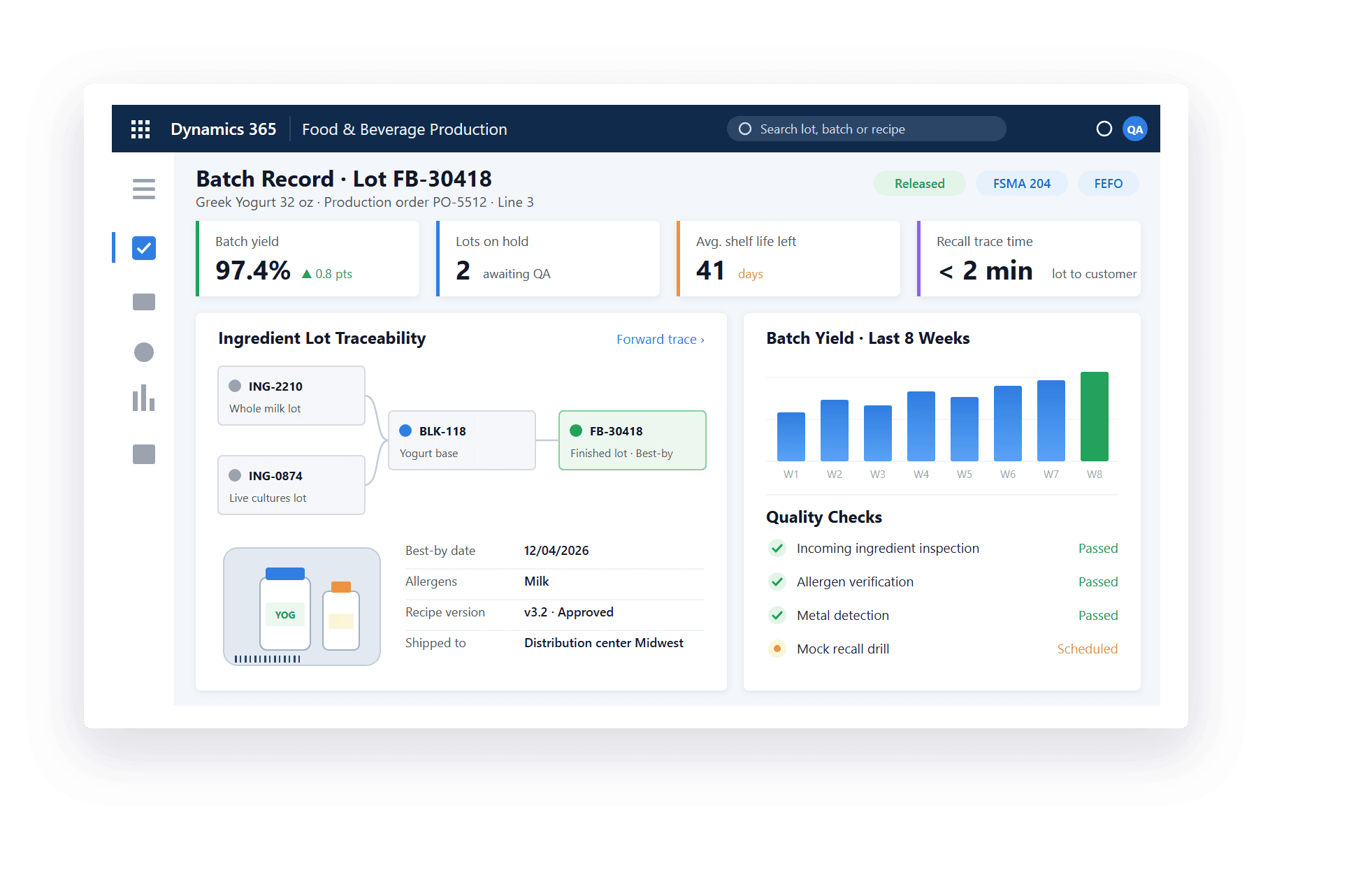
This means recipes, ingredient lots, production orders, expiration dates, quality checks, and financials live in a single database, so a finished case on a pallet can be followed back to the supplier lot of every ingredient inside it.
Dynamics Square recommends two products from Dynamics 365 suite for this work, and choosing between them is the first decision a food manufacturer faces.
This AI-powered Dynamics ERP for food and beverage manufacturing is built for growing producers who work from a defined recipe book at one or a few facilities, such as bakeries, specialty food makers, craft beverage companies, and co-packers.
It is built for large food and beverage producers whose recipes shift with ingredient quality, who generate co-products, who sell by variable weight, or who run several plants. Dairy, protein, ingredient manufacturing, and large beverage operations fit here.
FDA compliance depends on your food safety plan, trained employees, and accurate records. Dynamics 365 helps you maintain the lot history, expiration dates, and quality records needed to support these requirements. The sections below explain how each feature helps.
Compare the Two Products for My Plant
The Preventive Controls for Human Food rule (21 CFR Part 117) requires a food safety plan, allergen and supplier controls, and a recall plan, all backed by records. For Food Traceability List foods and products made with them, FDA's traceability rule adds key data elements at critical tracking events, a lot code on each transformed lot, two-year records and a sortable spreadsheet within 24 hours of a request.

Federal law names nine major food allergens, which are milk, eggs, fish, crustacean shellfish, tree nuts, peanuts, wheat, soybeans and sesame. A product carrying one while the label omits it is among the most common reasons food gets recalled, which is why allergen data needs to be tied to every item and recipe in the system.

Ingredients expire, finished goods carry best-by dates, yields differ from batch to batch, and some products sell by variable weight. Software that records only an item number and a count has to guess whenever it picks, plans or prices, so expiry dates, yields and weights need to sit on the lot record itself, where every transaction can read them.
Lot numbers attach to ingredients, intermediates, packaging, and finished goods. A production order consumes specific ingredient lots and creates a new lot for what comes out, which makes Dynamics 365 workable food batch manufacturing software from receiving dock to shipping dock.
Expiration dates are recorded when stock is received or produced, and warehouse picks pull the earliest-expiring lot first. Strict expiration posting keeps expired lots out of the pick altogether.
Each recipe holds dated versions with an approval status. In Supply Chain Management, formula quantities can follow batch size or ingredient percentage, so this functions as recipe and formula management software for plants that adjust to raw material variation.
Inspections are created at receiving and at production output, and a failed lot is blocked from shipment until someone with authority releases it. Supply Chain Management brings quality orders, handling of non-conformances, and sampling plans.
Item tracing runs forward and backward through inventory, production, and sales. Start from one supplier lot and see the finished lots it went into and the customers who received them, which is the core of any food traceability software.
MRP and master scheduling turn demand into a production plan. For process plants, Supply Chain Management adds co-products, by-products, and catch weight items, and spreads cost across everything a run produces.
When it comes to Dynamics 365 ERP for food and beverage manufacturing, companies have two options, and the right pick follows from the way your recipes behave and the number of plants you run, as much as from company size.
| Aspects | Business Central | Supply Chain Management |
|---|---|---|
| Best fit | Bakeries, specialty food, craft beverage, co-packers | Dairy, protein, ingredient makers, multi-plant beverage |
| Manufacturing style | Production BOMs and routings (Premium license) | Formula-based process manufacturing with co-products and by-products |
| Recipe control | Versioned production BOMs with certification status | Formulas with approved versions, percentage-based and step-based quantities |
| Lot tracking | Lot numbers with expiration dates | Batch numbers with attributes, batch merging, and reservation by attribute |
| Shelf-life controls | Expiration dates, strict expiration posting, FEFO picks | Shelf advice, best-before, and expiration dates, plus per-customer sellable days |
| Variable-weight products | Typically added through a partner app | Catch weight items |
| Quality management | Quality Management module with lot blocking | Quality orders, non-conformance handling, sampling plans |
| Allergen data | Item attributes or partner apps | Batch attributes set up around your allergen list |
| Multi-entity complexity | One operation, one legal entity | Multiple entities, sites, and currencies |
| Typical profile | Growing producer with 1 to 3 facilities | Process-heavy or multi-plant producer |
| Starting license (USA) | From $110 per user per month (Premium) | From about $210 per user per month (Standard) |
A producer that bakes, blends, bottles, or packs from a stable set of recipes will find Business Central Premium covers the daily work, including lot control, expiration handling, and quality inspection, with a lighter budget and a shorter rollout than a full enterprise platform.
A producer whose formulas change with ingredient strength, whose runs yield saleable by-products, whose cases are weighed individually, or whose production spreads across plants needs the process engine inside Supply Chain Management.
Dynamics 365 links allergen data to items and recipes, making allergens visible wherever a product is used. Your food safety team manages cross contact prevention, sanitation procedures, label artwork, and ingredient statements using appropriate tools. During discovery, we define how allergen data flows between these systems to support accurate labelling and food safety processes.
The best ERP for food and beverage manufacturing is the one shaped around your process, and Dynamics 365 offers two shapes to choose from. Food manufacturing ERP software sized above your needs adds cost and months to the project, and software sized below them leaves your team patching gaps in spreadsheets.
Your recipes are defined, your production runs from one or a few facilities, and you want lot tracking, expiration control, and quality inspection at a price and pace suited to a mid-sized business.
Formulas scale by percentage, runs produce co-products, products are sold by variable weight, or production spans multiple plants and companies.
Every food and beverage prospect gets this assessment from us before any platform is recommended.
Request a Fit AssessmentOur Dynamics 365 implementation for food manufacturers follows Microsoft's Success by Design framework, and food safety requirements enter the project plan at the first workshop.
Dynamics Square consultants walk the floor from receiving to shipping and document your recipes, lot practices, and the records your auditors ask for.
This stage includes working with your leadership team to settle scope, product choice, and who owns recipe and item data before configuration begins.
Next, Dynamics Square consultants configure your lot, expiration, and quality rules, then loads recipes and item master data from your existing records.
Dynamics Square runs real production days through the system with your team, trains supervisors and warehouse staff, and rehearses a mock recall.
We stay on hand through your first audits, new product launches, and recipe changes, supporting supervisors and quality staff.
Each license is billed per user per month, and the current US list prices appear in the cards. Besides, partner apps for label printing or scale integration, and the number of full versus occasional users, move your total and final pricing.
It includes finance, sales, purchasing, and inventory with lot tracking.
The tier for shop-floor work, with production orders, recipes as BOMs, MRP, and Quality Management.
It lets occasional users view data, approve requests, and make light updates.
Formula-based production, catch weight, and quality orders.
It extends Standard with deeper analytics and financial planning.
Over time, implementation costs can exceed the cost of software licenses. A single facility using Business Central usually needs a simpler setup. A company running Supply Chain Management across several plants needs more work, including transferring recipes and setting up product tracking. We assess your requirements and provide a written quote based on the work involved.
Price My Food Manufacturing ProjectLot practices, shelf-life rules, and recall drills shape how we scope each project, because we start from how your plant runs.
You get a direct recommendation for your food and beverage manufacturing ERP, Business Central or Supply Chain Management, based on the way your recipes and plants work.
Dynamics Square has over 35 certified manufacturing consultants who work with both products and can help you choose the right solution based on your business needs.
Dynamics Square stays involved through seasonal runs, new SKUs, recipe revisions, and audits.
For producers working from set recipes at one or a few facilities, it is a strong match. Formula-driven process plants with co-products or many sites are better served by Supply Chain Management.
Lot numbers carry through purchasing, production, inventory, and sales, and the Item Tracing page follows a lot in either direction.
Expiration dates are captured at receipt or production. With Pick According to FEFO switched on at the location, warehouse picks take the earliest-expiring lot first, and strict expiration posting excludes expired stock.
Allergens are recorded as item attributes or through partner apps. Your food safety plan decides what controls surround that data.
Production BOMs hold fixed quantities per unit of output, with versions for approved changes. Recipes that scale by ingredient percentage belong in Supply Chain Management.

