
Your Journey to Dynamics 365 Starts Here!
Fill in your business details and let
us be your partner in growth.

Dynamics 365 ERP for Electronics Manufacturing connects your BOM, your component inventory, and your production schedule on one platform. Dynamics Square has a team of certified Microsoft professionals with deep industry expertise that have built ERPs for electronics manufacturers before.
Years of Experience
Certified Dynamics 365 Consultants
Clients Worldwide
Business Central & Supply Chain Management Expertise
USA, Canada & UK Coverage
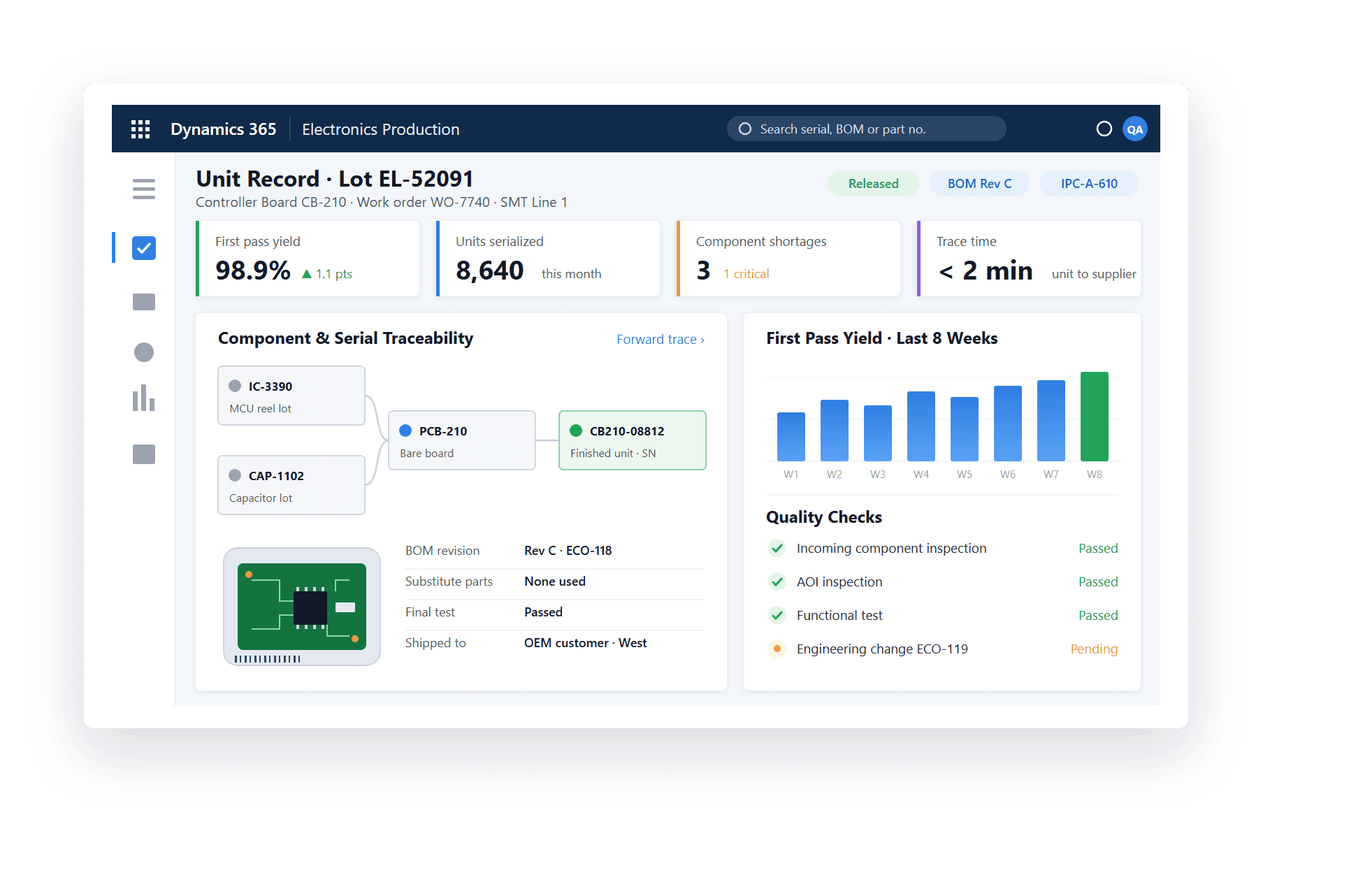
Dynamics 365 ERP for electronics manufacturing brings production, purchasing, quality, and finance into one shared system, so a design change or a last-minute part substitution updates everywhere it needs to, at the same moment it happens.
As a Microsoft Solutions partner, Dynamics Square knows this better than the most. We know that building circuit boards, assemblies, and finished electronic products means living with deep bills of materials, engineering revisions that land on no fixed schedule, and component sourcing that can shift week to week.
Microsoft splits this work across two products, and your actual BOM and supply chain behavior decide which one you start with, not company size alone.
Dynamics 365 Business Central is built for an electronics contract assembler or single-facility manufacturer running a defined product line against a workable, multi-level BOM.
Dynamics 365 Supply Chain Management is meant for an electronics manufacturer handling frequent engineering change orders, configure-to-order or engineer-to-order work, and sourcing spread across multiple sites or entities.
Your customer certifications and your supplier relationships stay your job to build and maintain, software never does that part for you. Where the right Dynamics 365 setup earns its keep is accurate BOMs, visibility into every component, and traceability on every unit, which makes holding up those commitments a lot easier. We walk through exactly how further down this page.
See Which Product Fits Your Operation
A single circuit board assembly can carry hundreds of line items across several BOM levels, and an engineering change to one component ripples through every assembly that uses it. Generic ERP tracks a flat parts list. Electronics manufacturing needs bill of materials software for electronics manufacturing that understands revisions, effective dates, and where a changed part is already committed to production.

Lead times on key components can stretch from weeks to many months with little warning, and a single missing part can stall an entire production run. Planning built around steady supply works fine until the first time a critical component goes on allocation, and then it falls apart fast.

Warranty claims, field failures, and customer audits all come back to the same question: which components, from which supplier lot, went into this specific unit. With serial number tracking software built into daily production, that answer comes back in minutes.
Deep, multi-level bills of materials stay linked to production, with revision history and effective dates that keep an engineering change from getting lost between design and the shop floor.
Component inventory management software built into the ERP flags low stock against real lead times, supports allocation when a part runs short, and keeps approved substitutes ready as a planned backup.
A component lot or a serialized board picks up its identifier the moment it enters the building, and that identifier stays attached through assembly and final test, so you can trace forward to a shipment or backward to a specific supplier delivery on demand.
Production plans that flex between standard runs, configure-to-order builds, and one-off engineer-to-order projects, without forcing every order through the same rigid process.
Business Central ships with inspection checkpoints built against IPC-A-610 acceptance criteria right out of the box, pass/fail grading included, with a failed unit moved aside automatically. Step up to Supply Chain Management and that same workflow gains structured non-conformance cases and statistical sampling for a heavier quality operation.
MRP and MPS turn demand into a realistic schedule against actual capacity, flagged component shortages, and supplier lead times, so the plan reflects what the floor can genuinely build this week.
A search for "Dynamics 365 for electronics manufacturing" tends to assume a single product is waiting at the other end. Microsoft actually ships two for this job, and the table below sorts out which one matches how deep your BOMs run and how your supply chain actually behaves.
| Aspects | Business Central | Supply Chain Management |
|---|---|---|
| Best fit | Contract manufacturers, single-site assemblers | Multi-site manufacturers, complex engineering environments |
| Manufacturing style | Discrete manufacturing (Premium license) | Discrete manufacturing at enterprise scale |
| BOM and engineering complexity | Multi-level BOMs, production BOM versions | Native Engineering Change Management, full version and release control |
| Lot and serial tracking | Native | Native, with multi-attribute tracking |
| Quality management | Native inspection templates and quarantine | Quality orders, non-conformance management, statistical sampling |
| Production approach | Standard and light configure-to-order | Configure-to-order and engineer-to-order natively |
| Multi-entity complexity | Single mid-sized operation | Multi-entity, multi-site, multi-currency |
| Starting license (USA) | Premium: $110/user/month | Standard: approximately $210/user/month |
A contract assembler running one product line out of one building, with a BOM that holds steady between revisions, lands squarely on Business Central Premium. The manufacturing and quality functionality scales to that size of operation, at a fraction of what an enterprise platform would cost for the same job.
Weekly engineering changes, a production mix of configure-to-order and engineer-to-order work, or sourcing and assembly spread across several sites all point the other way. Supply Chain Management's native Engineering Change Management module was built to carry exactly that load.
Manufacturers running a dedicated product lifecycle management system for design data typically connect it to Supply Chain Management's Engineering Change Management module, so an approved design revision flows into the ERP's BOM and routing data automatically.
Business Central manufacturers usually manage this link more manually through production BOM versions. We'll map out the right approach during discovery.
The honest answer is whichever platform matches your actual BOM complexity and production model, nothing more absolute than that. Pick the wrong one and the cost shows up twice: once in a build that never quite fits your scale, and again in every workaround your team improvises to patch the gap afterward.
You're assembling a defined product range out of one facility, your BOM stays stable for weeks or months at a stretch, and you want real manufacturing and quality functionality at mid-market pricing.
Engineering change orders land on a regular basis, your production mix includes configure-to-order or engineer-to-order work, or sourcing and assembly span more than one site or legal entity.
Every electronics prospect walks through this same assessment with us before a platform name ever comes up, because the tool gets chosen to fit the operation, not the other way around.
Get Your Free Fit AssessmentWe run every electronics engagement through Microsoft's Success by Design methodology, and we front-load BOM validation and component data migration into the schedule so neither one becomes a late surprise.
Map your BOM structure, your production mix, and where component sourcing creates the most risk today.
Confirm platform choice, scope, and project governance before configuration begins.
Configure the system, migrate BOM and item data, and connect any PLM or component sourcing tools in step with the build.
Your floor supervisors and planners run the system against real orders before go-live, build familiarity through hands-on training, and lock a cutover date that avoids your busiest production week.
We stay on after go-live, through the first round of engineering changes, supplier swaps, and whatever planning adjustments your early weeks on the new system turn up.
Dynamics 365 pricing for electronics manufacturers depends on your user count, any PLM or component-data integration work, and how much implementation scope the project actually needs.
Core financials, sales, purchasing, and inventory.
Adds production orders, BOMs, routings, MRP, MPS, and native Quality Management.
Read, approve, and self-service access.
Full discrete manufacturing, native Engineering Change Management, advanced quality management.
Adds advanced analytics and financial planning.
Licensing rarely ends up the bigger expense. Budget roughly $25,000 to $45,000 all in for a single-facility Business Central assembly line, configuration and go-live included. A Supply Chain Management rollout spanning several sites, with PLM connectivity and a heavier BOM migration behind it, can run past $150,000 before the project wraps.
Get a Custom Quote for Your FacilityA kickoff conversation with us starts at your bill of materials and your component sourcing risk, not your chart of accounts, because that's where an electronics implementation actually succeeds or fails.
Fit drives the recommendation, full stop. You hear Business Central when Business Central fits, and Supply Chain Management when the complexity genuinely calls for it.
Every consultant on our bench builds hands-on in both Business Central and Supply Chain Management on a regular basis, which is exactly why they can tell you honestly which one your operation actually needs.
A production line keeps changing long after it goes live. Component substitutions, new engineering revisions, and planning tweaks keep landing on our desk alongside yours.
A missing component can stop a line cold, and that reality shapes how closely we stay involved in your planning and sourcing process long after the implementation wraps.
Yes, for smaller and mid-sized manufacturers and contract assemblers running a defined product line from one facility. Operations with constant engineering change or multi-site production typically need Supply Chain Management instead.
Yes, Business Central Premium supports multi-level BOMs with production BOM versions, so a revision gets tracked and applied without manually rebuilding the structure.
Yes, tag a component by lot or serial number as it comes in or goes through production, and the system keeps that tag attached across purchasing, assembly, and the eventual shipment out the door.
To a point. Business Central handles light configuration and standard production well. Frequent configure-to-order or engineer-to-order work at scale is where Supply Chain Management's native capability takes over.
It can, usually through a manual or lightly automated link using production BOM versions. Deeper, automatic PLM-to-ERP engineering change flow is a Supply Chain Management strength, through its native Engineering Change Management module.
Get the component visibility, traceability, and planning accuracy that let your team build with confidence, even when the supply chain turns volatile.

